Prognostic Scoring Systems for Cancer-Specific Mortality in Differentiated Thyroid Carcinoma
A Systematic Review and Meta-Analysis
1 Intern Physician, Department of Internal Medicine, Wangaya Regional General Hospital (RSUD Wangaya), Denpasar, Bali, Indonesia
2 Endocrinologist - Consultant in Endocrinology, Metabolism, and Diabetes (Sp.PD-KEMD), RSUD Wangaya, Denpasar, Bali, Indonesia
Correspondence: ibhaskaradit@gmail.com
INTRODUCTION & EPIDEMIOLOGIC BURDEN
Most common endocrine malignancy with lowest overall mortality (0.6 per 100,000). However, global incidence has surged 3-fold over the past 20 years, with cancer-specific mortality rising 0.82% in the United States.
Differentiated Thyroid Carcinoma (DTC) accounts for 90% of all thyroid cancers, predominantly Papillary Thyroid Carcinoma (PTC, ~80%), followed by Follicular Thyroid Carcinoma (FTC, ~10%).
DTC carries favorable 10- and 20-year cancer-specific survival (CSS) of 97.2% and 93.4%. Precise risk stratification is essential to guide clinical decision-making between conservative surveillance and aggressive adjuvant therapy, while avoiding overtreatment.
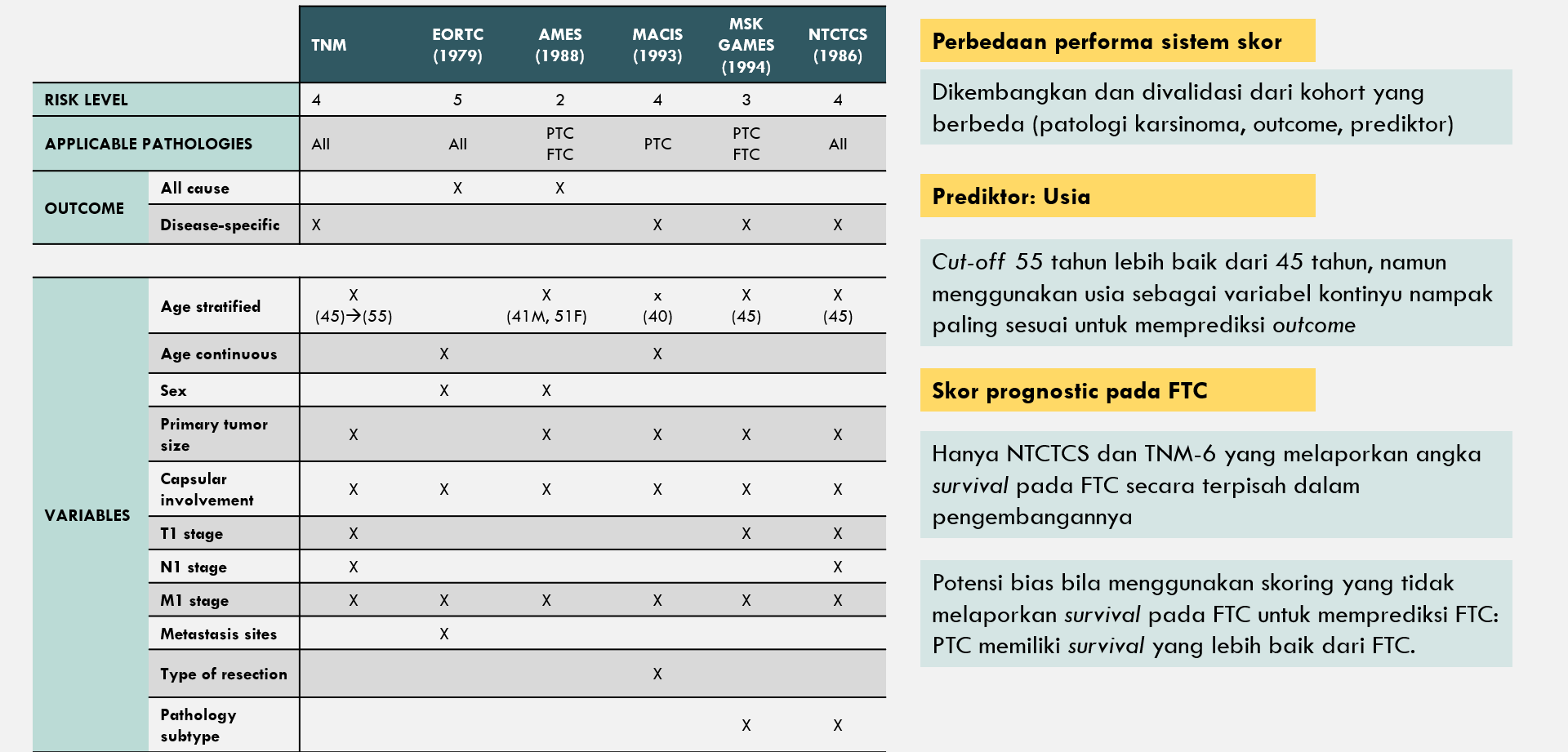
Multiple staging systems have been developed to predict mortality risk (e.g., EORTC, AMES, MACIS, NTCTCS, MSK-GAMES, and AJCC/UICC TNM). However, no single scoring system has gained universal consensus as the most optimal predictor across all histological subtypes.
“To evaluate and compare the predictive performance of EORTC, AMES, MACIS, MSK-GAMES, NTCTCS, and AJCC/UICC TNM scoring systems for 10-year cancer-specific mortality (CSM) in adult DTC, and specifically in PTC and FTC.”
METHODS: PICO FRAMEWORK & PRISMA 2020 FLOW
“How do the EORTC, AMES, MACIS, MSK-GAMES, NTCTCS, and AJCC/UICC TNM staging systems compare in predicting 10-year cancer-specific mortality in adult patients with DTC, PTC, and FTC?”
Adults (≥18 y) with DTC, and specifically with PTC and FTC histological subtypes.
Prognostic staging systems: EORTC, AMES, MACIS, GAMES, NTCTCS, AJCC TNM (5th–8th eds).
Comparative discrimination benchmark across all staging systems.
10-year CSM / CSS, quantified by C-index and Proportion of Variance Explained (PVE).
Post-thyroidectomy surveillance risk stratification (conservative vs aggressive therapy).
- Adults (≥18 y) with DTC, PTC, or FTC
- Reporting CSM or CSS outcomes
- Reporting PVE and/or C-index
- Full-text in English or Indonesian
- Non-CSM/CSS outcomes (OS, DSS, RFS)
- Incomplete manuscripts (abstract only)
- Missing data for standard error calc.
- Non-differentiated thyroid malignancies
PVE was summarized as median (IQR) and visualized using box plots. Pooled Concordance indices (C-index) were calculated via Bayesian random-effects meta-analysis using JASP software version 0.16.
Database searches (1986–2022):
Duplicates removed across 3 search engines:
Title and abstract evaluation against criteria:
Full-text articles scrutinized for eligibility:
Qualitative Synthesis
CONCEPTUAL PARADIGM & PROGNOSTIC METRICS
Evaluates Concordance Index (Discrimination) and Proportion of Variance Explained (PVE) across 10-year CSS cohorts
Classical staging systems were derived from institutional retrospective cohorts (Mayo, MSKCC, Lahey, EORTC) primarily focusing on macroscopic tumor burden and chronologic age. While TNM-8 and MACIS excel in discrimination (C-index 0.90 and 0.85), all systems fail to account for more than 55% of the total variance in patient survival (PVE ≤ 45%), highlighting an urgent need to supplement anatomic criteria with molecular pathology (e.g. BRAF V600E, TERT promoter mutations).
RESULTS: META-ANALYSIS & FOREST PLOTS
TNM-8 (DTC)COMPARATIVE MATRIX: PROGNOSTIC SCORING SYSTEMS
Review of components, risk tiers, and predictive criteria across all models
| System | Year | Risk Tiers | Pathology | Outcome | Age Mode | Sex | Tumor Size | Capsular / ETE | T / N / M | Resection | Histology |
|---|---|---|---|---|---|---|---|---|---|---|---|
| AJCC/UICC TNM | 2017 (8th) | 4 stages | All DTC (PTC & FTC) | Disease-Specific (CSM) | Stratified (55 y) | — | ✓ | ✓ (Gross ETE) | ✓ T, N, M | — | — |
| EORTC | 1979 | 5 levels | All DTC | All-cause Mortality | Continuous | ✓ (Male +) | ✓ | ✓ | M1 only + sites | — | — |
| AMES (Lahey) | 1988 | 2 tiers (Low/High) | PTC & FTC | All-cause Mortality | 41y (M), 51y (F) | ✓ | ✓ (>5 cm) | ✓ | M1 only | — | — |
| MACIS (Mayo) | 1993 | 4 groups | PTC only | Disease-Specific (CSM) | Continuous | — | ✓ (0.1 × cm) | ✓ (Invasion) | M1 (+3.0) | ✓ (Margin +1.0) | — |
| MSK-GAMES | 1994 | 3 tiers | PTC & FTC | Disease-Specific (CSM) | Stratified (45 y) | — | ✓ (≤4 vs >4 cm) | ✓ | M1 only | — | ✓ (Grade) |
| NTCTCS | 1986 | 4 stages | All DTC | Disease-Specific (CSM) | Stratified (45 y) | — | ✓ | ✓ | ✓ T, N, M | — | ✓ (Subtype) |
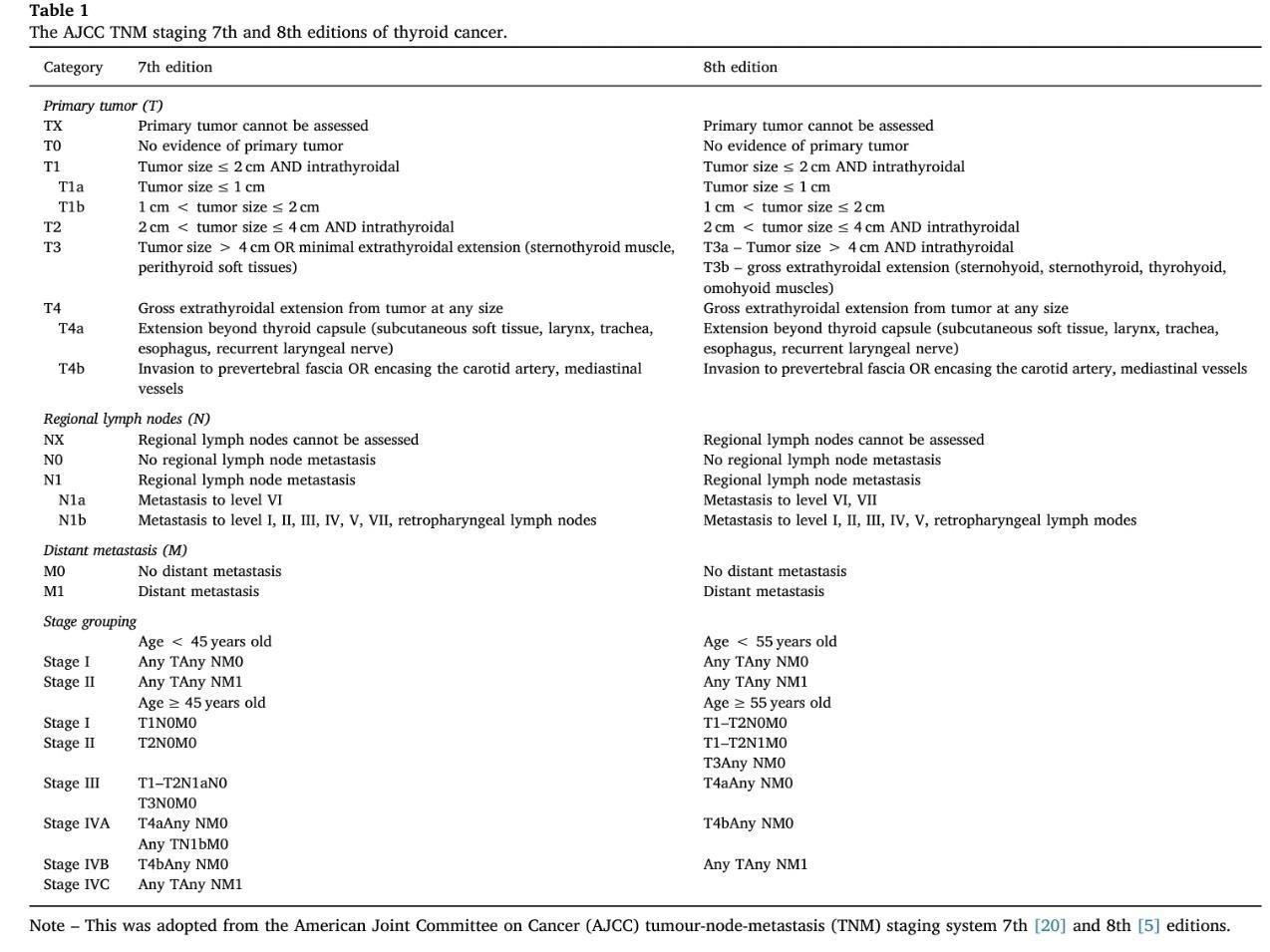
AJCC/UICC STAGING EVOLUTION: TNM-7 VS TNM-8
Key modifications and their profound clinical down-staging impact
Increased from 45 years to 55 years
Patients under 55 can only be classified as Stage I (M0) or Stage II (M1). This eliminates inappropriate overstaging of younger patients who have excellent long-term survival despite regional nodal spread.
Microscopic ETE removed from T3
In TNM-7, minimal extrathyroidal extension automatically upstaged tumors to T3. TNM-8 restricts T3b solely to gross invasion of strap muscles (sternohyoid, sternothyroid, thyrohyoid, omohyoid), avoiding overstaging of indolent microscopic capsular extension.
Downstaging to Stages I & II
Over 30% of older DTC patients were down-staged from Stage III/IVA to Stage I or II. Consequently, TNM-8 exhibits superior CSS discrimination (C-index 0.90) with progressively steeper, non-overlapping hazard ratios (HR) between stages.
DISCUSSION: CRITICAL ONCOLOGICAL INSIGHTS
Raising the age threshold to 55 years (TNM-8) significantly improves risk discrimination over 45 years (TNM-7). However, biological mortality risk increases continuously; treating age as a continuous variable (as in MACIS and EORTC) appears biologically most appropriate.
Only NTCTCS and TNM-6 separately validated survival in FTC cohorts during initial development. Applying systems dominated by PTC data to FTC creates bias, since FTC has higher hematogenous distant metastatic propensity and lower disease-specific survival.
Existing systems capture gross macroscopic anatomy but fail to integrate key molecular drivers (e.g. BRAF V600E, TERT promoter mutations) and detailed microvascular invasion. Furthermore, PVE artificially favors systems with more classification subgroups (higher degrees of freedom, e.g. TNM).
Because every system requires postoperative pathology, they cannot determine initial surgical extent (lobectomy vs total thyroidectomy). Their essential role is to guide postoperative follow-up intervals, thyroglobulin surveillance, and radioactive iodine (RAI) dosing.
CONCLUSION & CLINICAL PRACTICE TAKEAWAYS
TNM-8 possesses the highest discrimination for predicting 10-year cancer-specific mortality in DTC overall (pooled C-index 0.90), while MACIS demonstrates the highest discrimination specifically in PTC (pooled C-index 0.85).
No single scoring system is universally superior across both DTC and FTC/PTC in every metric. Because all median PVE values remain below 45%, future staging systems must integrate molecular genetics and histopathological subtypes into dynamic risk models.
TNM-8 (C-index 0.90) effectively avoids overstaging younger patients and minor capsular extension, providing superior stage separation.
MACIS (C-index 0.85) excels in Papillary Carcinoma due to its continuous age scoring and inclusion of surgical completeness.
Tailor radioactive iodine (RAI) dosing, Tg surveillance, and ultrasound intervals dynamically alongside molecular pathology.