Clinical Characteristics and Discriminative Ability of Prognostic Scoring Systems in Hepatitis B-Related Acute-on-Chronic Liver Failure
A Systematic Review and Meta-Analysis
1 Intern Physician, Department of Internal Medicine, Wangaya Regional General Hospital (RSUD Wangaya), Denpasar, Bali, Indonesia
2 Internist / Gastroenterologist-Hepatologist, Department of Internal Medicine, RSUD Wangaya, Denpasar, Bali, Indonesia
Correspondence: ibhaskaradit@gmail.com
INTRODUCTION & CLINICAL BACKGROUND
Acute-on-chronic liver failure (ACLF) is a devastating, life-threatening clinical syndrome distinct from acute liver failure and routine decompensated cirrhosis. It is defined by acute hepatic insult, rapid systemic deterioration, and severe short-term mortality (>70% without emergency transplantation).
Reversibility in the Golden Period: Despite fulminant progression and extreme short-term lethality, ACLF harbors substantial potential for full clinical recovery if identified and aggressively managed during the early "golden window".
Hepatitis B Virus (HBV) Epidemiology: Indonesia carries intermediate-to-high HBV endemicity. Chronic hepatitis B is the predominant underlying cause of ACLF throughout the Asia-Pacific region.
Lack of Universal Consensus: Two major diagnostic criteria predominate: APASL (Asia-Pacific) and EASL-CLIF (Europe). APASL was selected because it is representative of Asian/Indonesian HBV-predominant cohorts and detects patients prior to irreversible multiorgan failure.
Prognostic Scores: Multiple staging systems (CTP, MELD, MELD-Na, CLIF-C ACLF, CLIF-C OF, AARC, and COSSH) are used for clinical decision-making, intensive care triage, and liver allocation, but their comparative discrimination in HBV-ACLF has not been systematically established.
- 1. Synthesize the discriminative performance (C-statistic / AUROC) of prognostic scores for 28-day and 90-day transplant-free mortality in adult HBV-ACLF.
- 2. Establish the pooled prevalence of baseline cirrhosis, precipitating triggers, complications, and organ failure patterns.
METHODS: PICOTS FRAMEWORK & PRISMA 2020 FLOW
“What is the discriminative ability of MELD, MELD-Na, CTP, CLIF-C OF, CLIF-C ACLF, AARC-ACLF, and COSSH-ACLF in predicting 28-day and 90-day transplant-free mortality in adult HBV-ACLF patients without liver transplantation under APASL diagnostic criteria?”
Adults (≥18 y) with HBV-related ACLF diagnosed by APASL consensus criteria.
Model for End-Stage Liver Disease (MELD).
MELD-Na, CTP, CLIF-C OF, CLIF-C ACLF, AARC-ACLF, and COSSH-ACLF.
Transplant-free mortality, quantified by C-statistic / AUROC.
Short-term prognostic horizons: 28 days and 90 days post-admission.
Early clinical risk triage, medical therapy, and emergency liver allocation.
- Adults with compensated cirrhosis or non-cirrhotic CLD
- Severe jaundice: total bilirubin ≥ 5 mg/dL
- Coagulopathy: INR ≥ 1.5 or prothrombin activity < 40%
- Complicated within 4 weeks by ascites and/or encephalopathy
- Reporting external validation AUROC / C-statistic
- Non-English manuscripts or abstract-only reports
- Diagnostic criteria other than APASL or mixed definitions
- Non-HBV etiology or decompensated cirrhosis at baseline
- Mortality reported only > 90 days
- Patients receiving liver transplantation prior to outcome
Pooled prevalence synthesized with double-arcsine transformation via Meta-XL (Microsoft Excel). Pooled C-statistics calculated via Sidik-Jonkman random-effects method in JASP v0.16.0.0. Publication bias assessed via Egger's funnel asymmetry; study quality assessed with PROBAST.
Database searches across 3 sources:
Duplicates systematically removed:
Title and abstract evaluation:
Full-text scrutinized (18 excluded):
Full Synthesis Cohorts
POOLED CLINICAL CHARACTERISTICS & PREVALENCE
RESULTS: C-STATISTIC DISCRIMINATION META-ANALYSIS
28-Day MortalityCRITICAL APPRAISAL & RISK OF BIAS (PROBAST)
Prediction model Risk Of Bias Assessment Tool across 27 studies
High Reliability in Measurement: The vast majority of included studies exhibited low risk of bias in the Participant, Predictor, and Outcome domains, as predictors (laboratory values) and outcomes (all-cause death at 28/90 days) are objective and well-standardized.
Vulnerability in Analysis Domain: Risk of bias was high in the Analysis domain across 70% of studies. This was driven primarily by two methodological shortcomings: (1) death events < 100 in smaller validation samples, and (2) complete-case analysis without explicit reporting of missing data handling strategies.
ACLF DEFINITIONS: EAST (APASL) VS WEST (EASL-CLIF)
Comparative appraisal of diagnostic paradigms and suitability for Indonesia
| Diagnostic Domain | EASL-CLIF Criteria (West / Europe) | APASL Criteria (East / Asia-Pacific) |
|---|---|---|
| Underlying Chronic Liver Disease | Exclusively strictly acute decompensation of cirrhosis. | Compensated cirrhosis OR non-cirrhotic chronic liver disease (CLD). |
| Acute Precipitating Insults | Alcohol, hepatotoxic drugs, hepatotropic viruses, surgery, sepsis, variceal bleeding. | Alcohol, drugs, hepatotropic virus reactivation (HBV flare), surgery, trauma. |
| Primary Organ Failure Concept | Multisystem organ failure (6 organs via CLIF-C OF, especially renal; hepatic is only one component). | Acute hepatic failure is the primary core prerequisite (Bilirubin ≥ 5 mg/dL + INR ≥ 1.5). |
| Precipitation Onset Horizon | Not strictly limited to a defined time interval. | Rapid onset: complicated by ascites and/or encephalopathy within ≤ 4 weeks. |
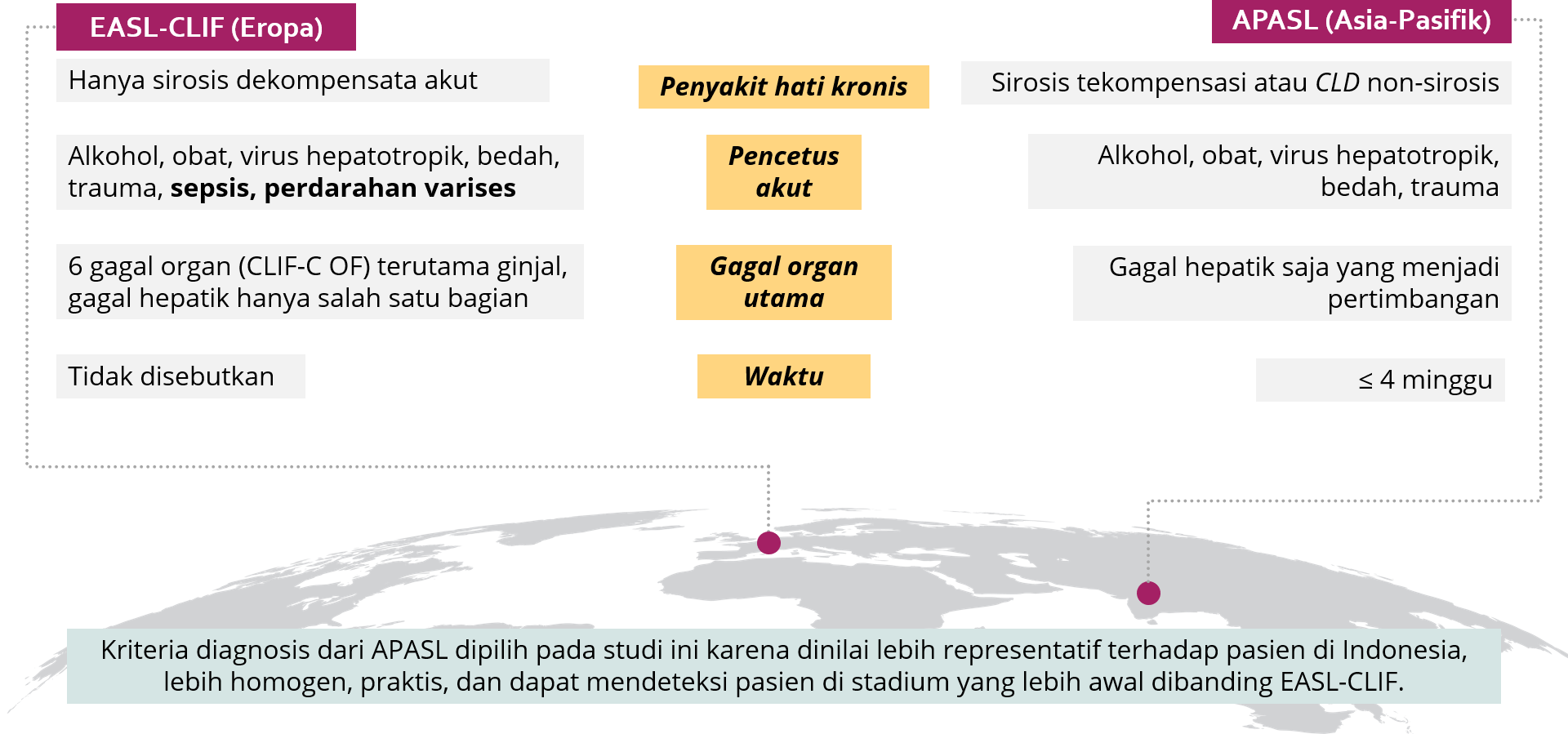
APASL diagnostic criteria were deliberately selected for this study because they are significantly more representative of liver pathology in Indonesia and the broader Asia-Pacific region. Unlike Western Europe where alcoholic decompensated cirrhosis predominates, Indonesian epidemiology is driven by endemic chronic hepatitis B. APASL offers a more homogeneous cohort, practical bedside criteria, and enables detection of patients at an earlier stage before irreversible extrahepatic multiorgan shutdown occurs.
PROGNOSTIC SCORING SYSTEMS ARCHITECTURE
Mathematical formulas, organ failure weighting, and cohort derivation backgrounds
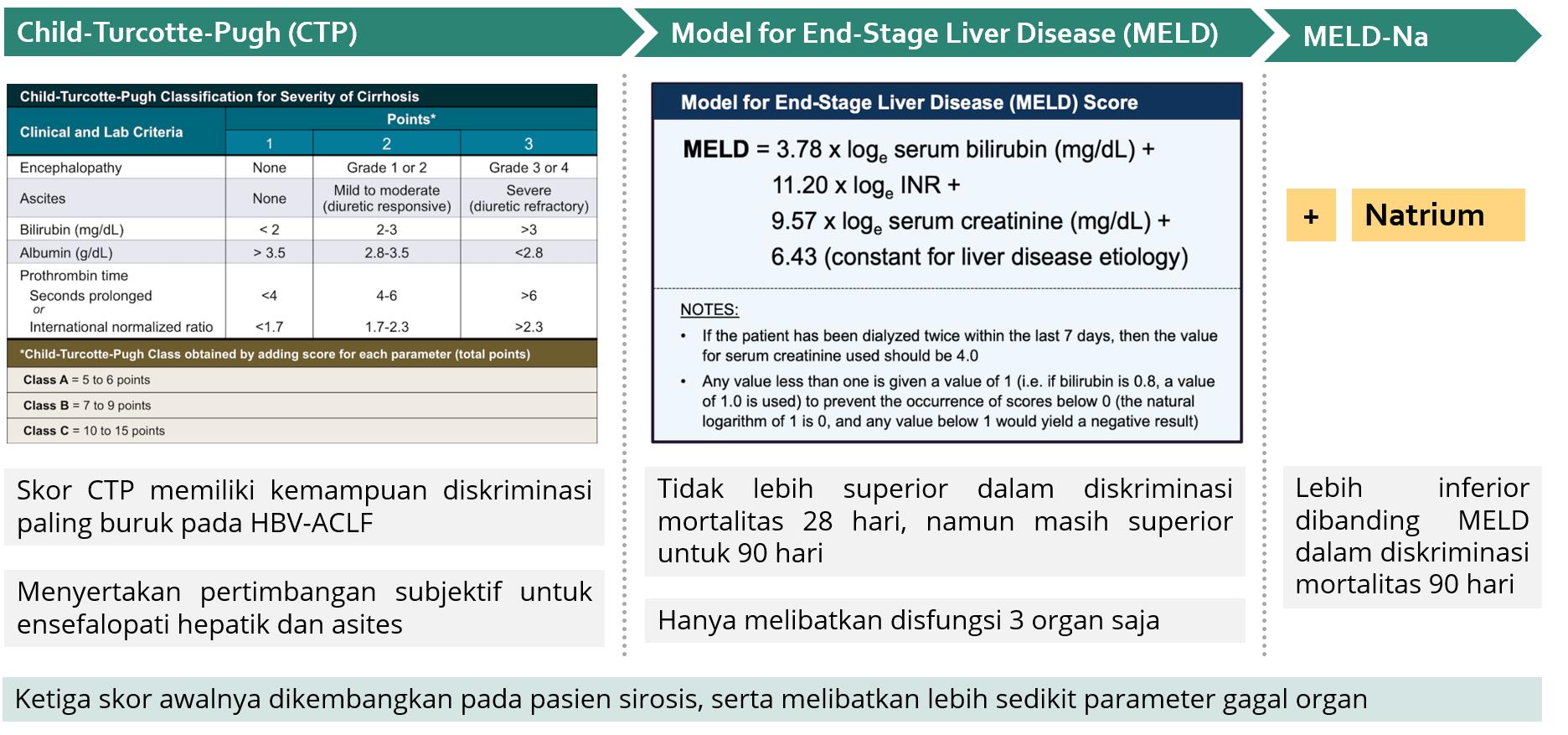
Scores bilirubin, albumin, INR, and subjective categories of ascites and encephalopathy (5–15 points).
Captures 3 organ systems (liver, coagulation, kidney). Demonstrates solid baseline discrimination (C-index 0.75).
Adds serum sodium to account for ascites/hemodynamic strain. However, in HBV-ACLF, MELD-Na was slightly inferior to classic MELD for 90-day mortality (0.71 vs 0.75).
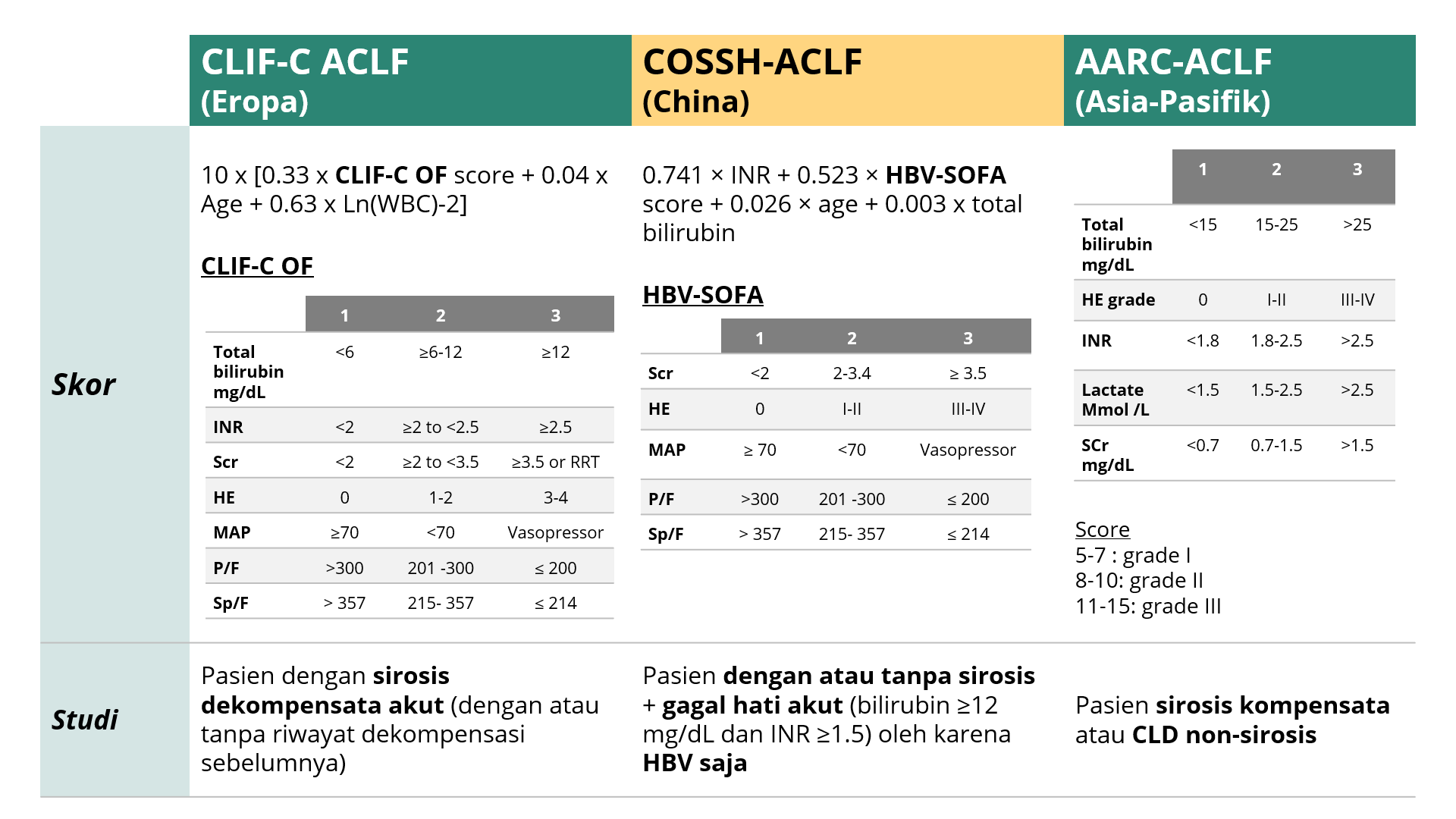
Assesses 6 organ systems (liver, kidney, brain, coagulation, circulation, respiration) + age + WBC count.
Strong 28-day discrimination (C-index 0.80–0.83), but derived from Western alcoholic cirrhosis.
Asian consortium score incorporating total bilirubin, hepatic encephalopathy grade, INR, lactate, and creatinine (C-index 0.79 at 28d, 0.71 at 90d).
Specifically developed from an exclusive HBV-ACLF cohort (Wu et al. Gut 2017). Modifies CLIF-C OF organ failure thresholds to fit acute intrahepatic necrosis, delivering the highest discrimination at 28 days (0.84) and 90 days (0.78).
DISCUSSION & COHORT BENCHMARKING
HBV-ACLF in the Asia-Pacific region is characterized by severe acute hepatocellular destruction following viral flares, reflected in pooled liver failure (78%) and coagulopathy (26%). This contrasts with Western alcoholic ACLF where extrahepatic renal (kidney) and circulatory failures dominate.
The pooled clinical parameters synthesized in this meta-analysis (51% cirrhosis, 60% ascites, 24% HE, 31% 28d mortality) closely align with the original COSSH development and validation cohorts (Wu et al. Gut 2017), explaining why COSSH-ACLF consistently yields superior discriminative C-statistics.
Scores incorporating organ failure criteria (COSSH-ACLF, CLIF-C OF, CLIF-C ACLF) consistently outperformed classical cirrhosis models (MELD, MELD-Na, CTP). Because ACLF mortality is governed by systemic inflammatory cascade and extrahepatic organ collapse, multiorgan scoring is mandatory for accurate clinical triage.
Limitations include absence of calibration reporting (observed vs expected risk), high risk of bias in the PROBAST analysis domain in small studies, and origin of all studies from China. There is an urgent, indispensable need for prospective external validation in Indonesian HBV-ACLF cohorts.
CONCLUSION & CLINICAL PRACTICE TAKEAWAYS
COSSH-ACLF demonstrates the highest discriminative performance in adult HBV-ACLF patients for both 28-day (pooled C-index 0.84) and 90-day (pooled C-index 0.78) transplant-free mortality. Prognostic models incorporating comprehensive organ failure assessments should be preferred for early clinical triage and liver transplant prioritization.
COSSH-ACLF (0.84 at 28d, 0.78 at 90d) is specifically optimized for HBV etiology and intrahepatic failure, outperforming general hepatology scores.
Multiorgan scores (COSSH, CLIF-C) surpass traditional models (MELD, CTP). Organ failure assessment is indispensable in ACLF management.
Prospective external validation of COSSH-ACLF and calibration assessments in Indonesian hospitals represent an urgent clinical priority.